
Why Do Cats Knock Things Over? Decoding Feline Psychology

⚡ TL;DR – Quick Safety Summary
- •Knocking things over is often driven by a cat's natural hunting instinct and prey drive
- •Cats use their paws to explore the texture, weight, and movement of objects
- •Attention-seeking behavior is a learned response; they know you will react
- •Provide active toys and structured play sessions to redirect this behavior
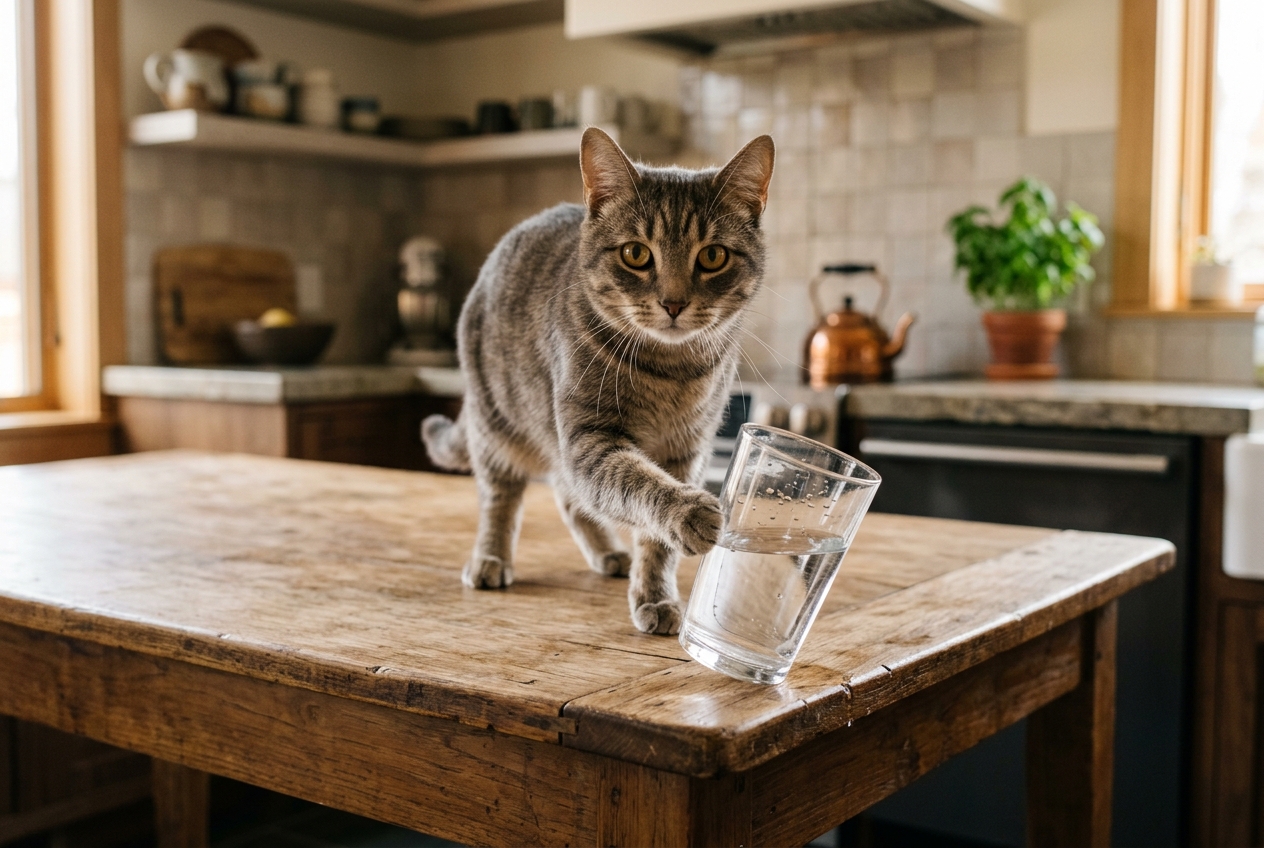
It’s a scene every cat owner knows all too well: Your cat is sitting on the counter. They spot a pen, a key, or a glass of water. They walk over, look you dead in the eye, slowly raise a paw, and nudge the object off the edge.
Crash.
While it can feel like your cat is doing this out of sheer spite, there is actually a fascinating set of psychological and evolutionary reasons behind why cats knock things over.
1. The Hunting Instinct (Prey Play)
At their core, domestic cats are highly efficient predators. In the wild, a cat’s survival depends on their ability to detect and capture small, fast-moving prey like mice, insects, and birds.
When a cat nudges a pen on your desk, they are often testing it to see if it is "alive." By tapping the object, they observe how it rolls, bounces, or slides. If it moves, their brain registers it as potential prey, triggering their predatory drive to chase and pounce.
2. Tactile Exploration
Cats do not have hands to grab and feel objects, so they use their sensitive paw pads to explore the world around them.
A cat’s paw pads contain a high concentration of nerve endings that allow them to gather detailed sensory information about their environment. By batting at an object, they are testing its weight, texture, stability, and temperature. Knocking it off the table is simply the logical conclusion of their physical investigation: they want to see what happens when it falls.
3. The Ultimate Attention Grabber
Cats are incredibly observant creatures, and they are excellent at recognizing cause-and-effect relationships.
Think about what happens when your cat knocks a glass off the table:
- You gasp or yell.
- You jump up from the couch.
- You walk over to clean it up.
- You might talk to or scold them.
To a bored cat, even negative attention is a win. They quickly learn that nudging objects off surfaces is a guaranteed way to get you to stop whatever you are doing (like working on your laptop or watching TV) and focus entirely on them.
How to Redirect the Behavior
If your cat is turning your home into a demolition zone, you can redirect their energy with a few simple adjustments:
- Schedule Interactive Play: Use wand toys or laser pointers for 10-15 minutes twice a day to satisfy their natural hunting instincts.
- Rotate Toys: Keep toys fresh by putting some away and bringing out others every week to prevent boredom.
- Provide Independent Puzzles: Treat-dispensing toys and food puzzles keep their minds active and reward their physical efforts safely.
- Clear the Launchpads: Keep fragile or dangerous items off counters and tables that your cat frequently visits.
- Ignore the Auditions: If your cat is nudging a safe item (like a plastic bottle cap) to get your attention, try to ignore them completely. If you react, you reinforce the behavior.
Sponsored Placement